dr. Ulici Claudiu-Octavian
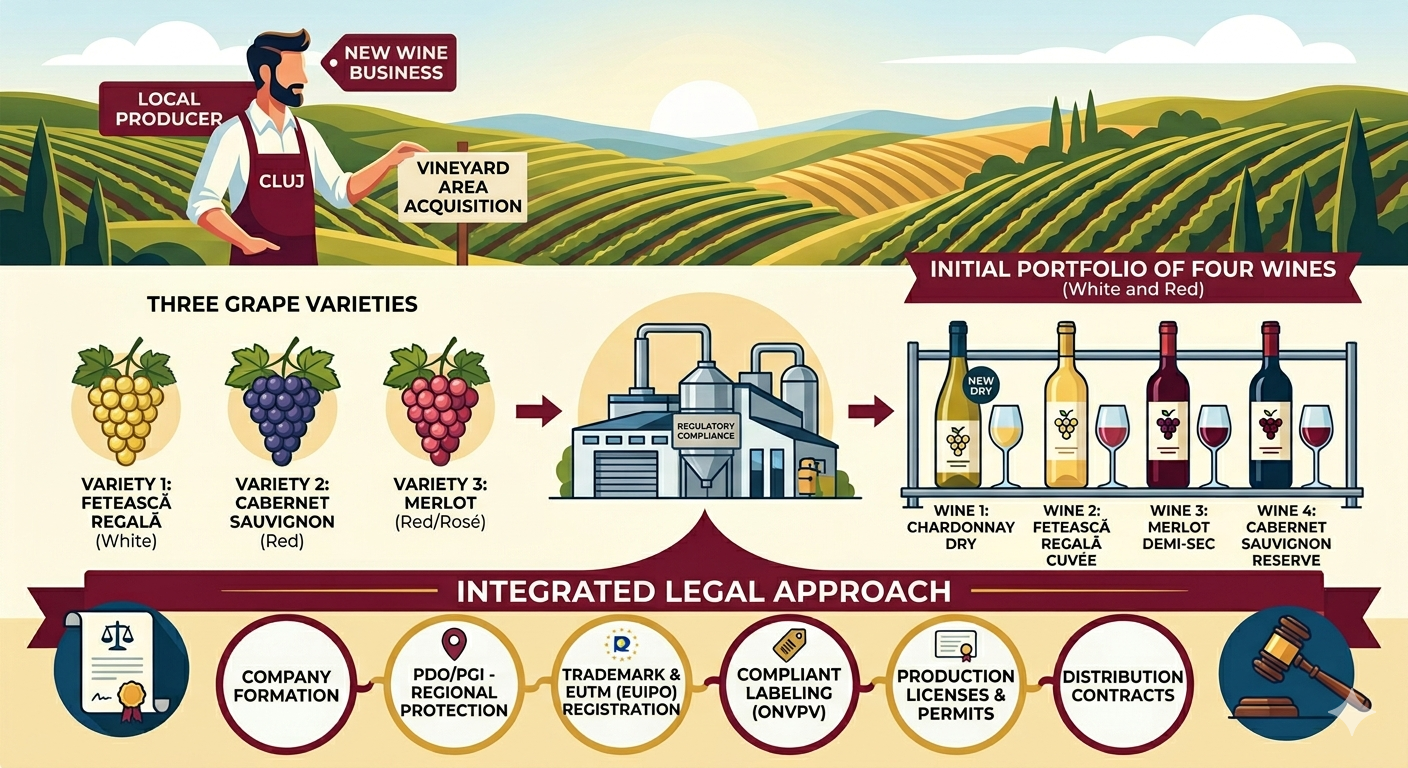
Launching a new venture in the viticultural sector represents a major, long-term capital investment governed by an exceptionally strict and fragmented regulatory framework. When a local producer purchases a vineyard, leveraging three distinct grape varieties to bring an initial portfolio of four separate wines (both white and red) to market, the legal approach must be comprehensive and integrated.
In this industry, commercial value is not merely derived from the physical quality of the liquid in the bottle; it stems from the reputation accumulated under a specific brand and the exclusive right to utilize a Protected Designation of Origin (PDO/DOC). To secure this value and prevent the risks of infringement or administrative sanctions, an industrial and intellectual property strategy must be structured across three distinct pillars.
1. Trademark Protection: The Winery Name and Product Brands
A producer’s family name, when utilized to identify a commercial activity within the alcoholic beverage sector, loses its status as a mere personal attribute and becomes a commercial trademark.
The mandatory first step consists of conducting a rigorous trademark clearance search. This analysis goes far beyond a simple internet search, requiring a thorough investigation of official registries to detect prior identical or phonetically, visually, or conceptually similar marks registered for products under Class 33 (wines and alcoholic beverages).
From a strategic standpoint, the filing of applications is determined by the intended distribution market:
- The National Route: The application is filed with the State Office for Inventions and Trademarks (OSIM) if the business model targets exclusively the domestic Romanian market.
- The European Route: The application is submitted to the European Union Intellectual Property Office (EUIPO) as a European Union Trademark (EUTM). This approach provides uniform protection and commercial exclusivity across all 27 member states, making it essential for future export operations.
Registration should not only cover the name of the winery itself (the umbrella brand) but can also be extended to the specific names chosen for the four types of wine in the portfolio, provided they utilize fanciful terms rather than purely technical or commercial descriptions of the product. Furthermore, protection should proactively expand into Class 43 (services for providing food and drink; temporary accommodation), anticipating the future development of wine tourism facilities or tasting events at the estate.
2. The Legal Framework of Controlled Designations of Origin (DOC)
Unlike the winery’s name, a designation of origin cannot be registered as a private trademark for the benefit of a single producer. Geographical indications and designations of origin are collective rights belonging to all producers within a delimited geographic area who comply with a predetermined set of rules.
For the new wine to officially bear the “DOC” designation on its label, the producer must undergo a strict administrative procedure at the national level, managed by the National Office of Vine and Wine Products (ONVPV):
- Verification of Location: Certifying that the newly acquired vineyard plots lie entirely within the geographical boundaries established for that specific DOC region.
- Compliance with the Product Specification: Rigorous monitoring of the production process. Each DOC is governed by a product specification (caiet de sarcini) that imposes strict limits on grape yields per hectare, permitted varieties (out of the three owned), vinification methods, and the final analytical characteristics of the white or red wine.
- Obtaining the Right of Use: Following technical verifications by ONVPV inspectors, the producer is granted the authorization to market the wine under that designation of origin, along with the right to apply official serialized holograms to the necks of the bottles.
At the European Union level, once a wine is certified under a nationally recognized DOC, its protection is automatically guaranteed across the single market through its entry into the centralized eAmbrosia registry, prohibiting any unauthorized third party within the EU from utilizing or parodying the designation.
3. Label Compliance and Trade Secret Protection
A wine label is not merely a marketing tool; it is a legal document subject to regulatory oversight. Before printing and bottling, the graphic layout of the label must undergo a legal compliance audit. Regulations mandate the mandatory and legible inclusion of specific information, such as actual alcoholic strength by volume, indication of allergens (e.g., sulfites), lot number, quality category (DOC), nominal volume, and the identity details of the bottler. The final layouts must be submitted to regional ONVPV inspectorates for prior approval.
In parallel, while the external visual elements of the bottle (custom graphics, the UI/UX design elements of the label) can be protected at the EUIPO as Registered Community Designs (RCD), internal vinification procedures require contractual safeguarding.
The specific blending (cupaj) recipes for the four wine varieties, aging timelines, and fermentation techniques utilized constitute protectable trade secrets. Securing these assets requires implementing strict physical and technical security measures within the winery, alongside executing robust non-disclosure agreements (NDAs) with oenologists, winemakers, and auxiliary staff, drafted in strict compliance with European Directive 2016/943 on the protection of undisclosed know-how and business information.
The Role of Specialized Legal Counsel
Navigating this bureaucratic and legal framework requires dedicated legal counsel across multiple tiers of regulatory engagement:
- Representation before OSIM and the EUIPO: Managing the entirety of the examination proceedings, filing national and European trademark applications, drafting responses to provisional refusals, and handling defense arguments in the event of oppositions filed by competing brands.
- Representation before ONVPV and the Ministry of Agriculture: Preparing administrative files for vineyard plot verifications, assisting during compliance audits to secure DOC usage rights, and handling the pre-approval of commercial labels.
- Contractual Safeguards: Drafting employment contracts and non-disclosure agreements for technical staff, as well as structuring clauses within national or international distribution agreements designed to protect the brand’s exclusivity at retail outlets.
Securing industrial property rights from the outset and complying with the mandatory provisions of wine law ensures business continuity, transforming a vineyard from a simple agricultural operation into a highly valuable, legally protected commercial asset immune to unfair competition.
No responses yet