
dr. Octavian Ulici
In the globalized tech economy, building software using distributed talent is standard operational procedure. Startups and enterprise software houses routinely hire remote software engineers, independent contractors, or third-party development agencies across the European Union to scale production rapidly.
However, from a legal architecture perspective, a cross-border contractor pipeline introduces a hidden pitfall. A widespread—and legally dangerous—assumption among founders is that paying invoices for custom code automatically grants the company ownership over that code. Within the EU legal framework, this assumption is flatly incorrect.
Without precise, explicit written intellectual property (IP) assignment structures, your company may merely hold an implied, non-exclusive license to use the software, while the actual legal ownership remains with the individual developer who wrote it.
The Default Legal Presets: Why the Author Rules in the EU
To secure software assets within the European Single Market, one must first understand the default mechanism of European copyright law. The foundational framework is governed by Directive 2009/24/EC on the legal protection of computer programs.
Under this directive, software code is legally protected as a literary work, and the default owner of a literary work is always the human creator. The directive does provide an explicit statutory exception for traditional employment relationships:
Directive 2009/24/EC, Article 2(3)
“Where a computer program is created by an employee in the execution of his duties or following the instructions given by his employer, the employer exclusively shall be entitled to exercise all economic rights in the program so created, unless otherwise provided by contract.”
The critical danger point for tech companies lies in the word “employee.”
This automatic, statutory transfer of intellectual property rights applies strictly to individuals hired under local, formal labor contracts. It does not extend to independent contractors, remote B2B freelancers, or external development agencies.
If your remote developer operates through a freelance structure, invoices you monthly via a limited liability company, or works from a different jurisdiction as an independent contractor, they are not an employee under Article 2(3). Consequently, the moment they write a line of code, the initial copyright vests entirely in them. The fact that your enterprise financed the development is irrelevant under default EU copyright principles.
The Dual Architecture of European IP: Economic vs. Moral Rights
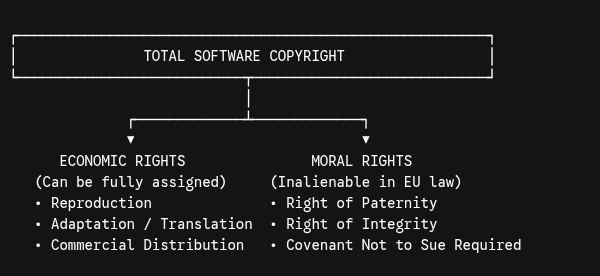
When drafting cross-border software agreements, you must account for the strict division in civil law jurisdictions between economic rights (droits patrimoniaux) and moral rights (droits moraux).
1. Economic Rights
These are the commercial rights required to exploit the software. They include the right to reproduce the code, translate it into other programming languages, adapt it, create derivative works, and distribute it commercially. Under EU law, economic rights can be fully assigned, but the contract must explicitly enumerate them. Vague clauses like “the company owns all work product” are routinely thrown out or interpreted restrictively by European courts. The contract must state that the developer transfers all present and future economic rights without geographical or temporal limitations.
2. Moral Rights
Unlike common law jurisdictions (such as the United States) where moral rights can be completely waived or assigned via “Work Made For Hire” doctrines, moral rights in Continental Europe are deeply tied to the creator’s personality. They are legally inalienable and cannot be sold, transferred, or fully waived. These include the right of paternity (the right to be publicly named as the author of the code) and the right of integrity (the right to object to modifications that might harm the author’s professional reputation).
If a disgruntled remote contractor realizes their contract only covered economic rights, they could attempt to leverage their inalienable moral rights to disrupt an acquisition or block code deployment by claiming an infringement of their authorship integrity. To mitigate this risk, agreements must include an enforceable, strict covenant where the developer explicitly agrees not to assert or exercise their moral rights against the company, its clients, or downstream assignees.
Drafting a Bulletproof B2B IP Assignment Agreement
To ensure that tech due diligence does not derail future venture capital funding or corporate exits, your B2B contractor agreements must feature a robust, explicit transfer mechanism.
Every contract must contain three non-negotiable clauses:
- The Present and Future Assignment Clause: The contract must state that the contractor hereby assigns, by way of present transfer of future rights, all intellectual property rights in any code, documentation, or architectural designs from the exact moment of their creation. This prevents any legal gaps between code execution and formal delivery.
- The Indemnification Wrapper: The external developer or agency must warrant that the code they deliver is completely original and does not infringe upon third-party intellectual property or violate open-source license boundaries. The clause must oblige the contractor to fully indemnify your enterprise against any third-party IP litigation resulting from their deliverables.
- Clear Governing Law and Jurisdiction: Cross-border enforcement is complex. The contract must explicitly state which Member State’s law governs the contract and designate a specific forum (typically the home jurisdiction of your enterprise) to handle disputes swiftly.
Operational Enforcement: Local Software Isolation Policies
Contractual provisions are defensive legal tools, but they must be paired with proactive technical isolation strategies to prevent intellectual property leakage before it occurs.
Granular Source Control Management
Never grant an external contractor unmonitored access to your complete, production-ready codebase. Utilize microservices architectures and granular access controls within version control platforms (such as GitHub or GitLab). Contractors should only be pulled into isolated, compartmentalized repositories necessary for their specific sprint tasks.
Enforcing Non-Local Hosting Mandates
Your operational protocols should mandate that no proprietary source code, internal system configurations, or raw staging databases are permitted to reside permanently on a contractor’s personal hardware or localized environments. All testing, compilation, and staging must occur within secure, company-controlled, containerized cloud environments (such as AWS, Azure, or Google Cloud) where access logs are continuously audited.
The Strategic Bottom Line
In the European technology ecosystem, corporate valuation is directly tied to the unassailable clarity of your intellectual property chain of title. Institutional investors and corporate buyers will not accept ambiguous ownership structures. If your core software architecture was constructed by external, cross-border talent, every single line of code must be traceably linked back to your corporate entity via clear, signed, and enforceable assignment agreements. Ensuring this legal alignment from day one is the only way to safeguard your corporate valuation and guarantee operational security across the European market.
No responses yet